
About
Learn More About Us
Harness the Power of the Cloud and Data-Driven Intelligence.
Welcome to your central resource for understanding and leveraging the transformative technologies of cloud computing and artificial intelligence.
- Virtualization: SaaS, PaaS, Iaas
- Postgresql and Mysql as a Service
- Machine Learning and Artificial Intelligence
Whether you are a seasoned developer, a business leader looking to innovate, or simply curious about the future of technology, this website will provide you with comprehensive content and clear visuals to navigate the exciting worlds of SaaS, PaaS, IaaS, managed databases, and AI-powered programming.
Learn MoreServices
Virtualization, SaaS, PaaS, IaaS, Managed Databases, Machine Learning, Artificial Intelligence.
Decoding the Cloud: SaaS, PaaS, & IaaS
Cloud computing offers a spectrum of services that provide businesses with the flexibility, scalability, and cost-effectiveness needed to thrive in the digital age. Understanding the three primary models of cloud service is the first step to unlocking its potential.
SaaS, PaaS, and IaaS are the three primary models of cloud computing services, each offering a different level of management and control. Infrastructure as a Service (IaaS) provides on-demand access to fundamental IT resources like servers, storage, and networking, giving you the most control over your virtual infrastructure. Platform as a Service (PaaS) offers a complete development and deployment environment in the cloud, managing the underlying hardware and software so developers can focus solely on building and running their applications. Finally, Software as a Service (SaaS) delivers ready-to-use software applications over the internet, where the provider manages everything from the software itself to the infrastructure it runs on, offering the ultimate convenience for end-users.
The primary benefit of Software as a Service (SaaS) is its powerful combination of accessibility, cost-efficiency, and convenience. Because applications are hosted in the cloud, SaaS eliminates the need for users to install, maintain, or update software on their local devices. This allows businesses and individuals to access the latest tools from anywhere with an internet connection while paying a predictable subscription fee rather than incurring large upfront hardware and licensing costs. Ultimately, it significantly reduces IT overhead and provides easy scalability, allowing organizations to instantly adjust their software usage as their needs evolve.

Infrastructure as a Service
Infrastructure as a Service, commonly known as IaaS, represents the foundational layer of modern cloud computing, fundamentally transforming how organizations provision and manage their technological assets. Instead of purchasing, maintaining, and housing physical hardware in expensive on-premises data centers, businesses can rent virtualized computing resources over the internet from a third-party cloud provider.
This highly dynamic model grants on-demand, instant access to essential infrastructure components such as virtual servers, highly scalable storage volumes, and sophisticated networking capabilities, including virtual private clouds, firewalls, and load balancers.
The most transformative advantage of IaaS lies in its unparalleled flexibility and economic efficiency. By operating on a strict pay-as-you-go pricing model, organizations successfully shift their IT spending away from heavy, upfront capital expenditures and toward predictable, usage-based operating expenses. This paradigm shift ensures that businesses only pay for the exact resources they actively consume, allowing them to rapidly scale up compute power during periods of intense demand—such as a global product launch or holiday shopping season—and seamlessly scale back down when traffic normalizes, entirely eliminating the financial waste associated with idle server capacity.
Furthermore, IaaS delegates the massive burden of physical facility security, hardware lifecycle maintenance, cooling, and power management to massive hyperscale providers like our company. By offloading these tedious operational responsibilities, internal IT teams are freed to focus exclusively on strategic business initiatives, complex application architecture, and rapid software deployment rather than replacing failed hard drives or racking servers.
Ultimately, Infrastructure as a Service democratizes access to world-class, enterprise-grade technology, empowering nimble startups and established global corporations alike with the agility needed to innovate quickly, deploy robust services globally in mere minutes, and implement highly resilient disaster recovery architectures without traditional financial constraints.

Database As a Service
Database as a Service (DBaaS) has fundamentally transformed how organizations manage their data by offloading tedious administrative tasks—such as hardware provisioning, software patching, and routine backups—to cloud providers. Within this managed cloud ecosystem, PostgreSQL and MySQL stand out as the two most dominant open-source relational database engines, each offering distinct advantages for modern applications.
PostgreSQL is widely renowned for its robust feature set, strict ACID compliance, and exceptional ability to handle highly complex queries, custom data types, and massive datasets. When deployed as a managed service through platforms like Amazon RDS, Google Cloud SQL, or Azure, developers can seamlessly leverage advanced PostgreSQL features—such as intricate JSONB support and PostGIS spatial extensions—without the traditional burden of configuring manual replication or tuning the host operating system. It remains the premier choice for complex enterprise applications requiring rigorous data integrity.
Conversely, MySQL has long served as the ubiquitous backbone of the dynamic web, celebrated for its blazing speed, widespread compatibility, and straightforward ease of use. In a DBaaS environment, managed MySQL services empower fast-paced startups and high-traffic platforms—such as e-commerce sites and content management systems—to handle massive volumes of read-heavy traffic by effortlessly deploying automated read replicas. DBaaS providers handle the complex deployment of multi-Availability Zone architectures for both database engines, ensuring continuous high availability, automated disaster recovery, and seamless failover. Furthermore, these managed services bake in enterprise-grade security, offering default data encryption both at rest and in transit.
Ultimately, whether an engineering team chooses the advanced, object-relational extensibility of PostgreSQL or the web-optimized, rapid performance of MySQL, adopting either through a DBaaS paradigm yields unparalleled operational efficiency. By shifting infrastructure management to cloud experts, organizations can refocus their valuable resources entirely on application development and strategic innovation.

Artificial Intelligence, Machine Learning
Artificial Intelligence (AI) is the broad field of computer science dedicated to creating machines that can perform tasks that typically require human intelligence, such as visual perception, decision-making, and understanding language. Machine Learning (ML) is a significant and powerful subset of AI. Instead of being explicitly programmed, ML uses algorithms to analyze vast amounts of data, identify patterns, and make predictions or decisions. Essentially, machine learning is the process that allows a computer system to learn and improve from experience, enabling the development of its intelligence and powering most modern AI applications, from virtual personal assistants to self-driving cars.
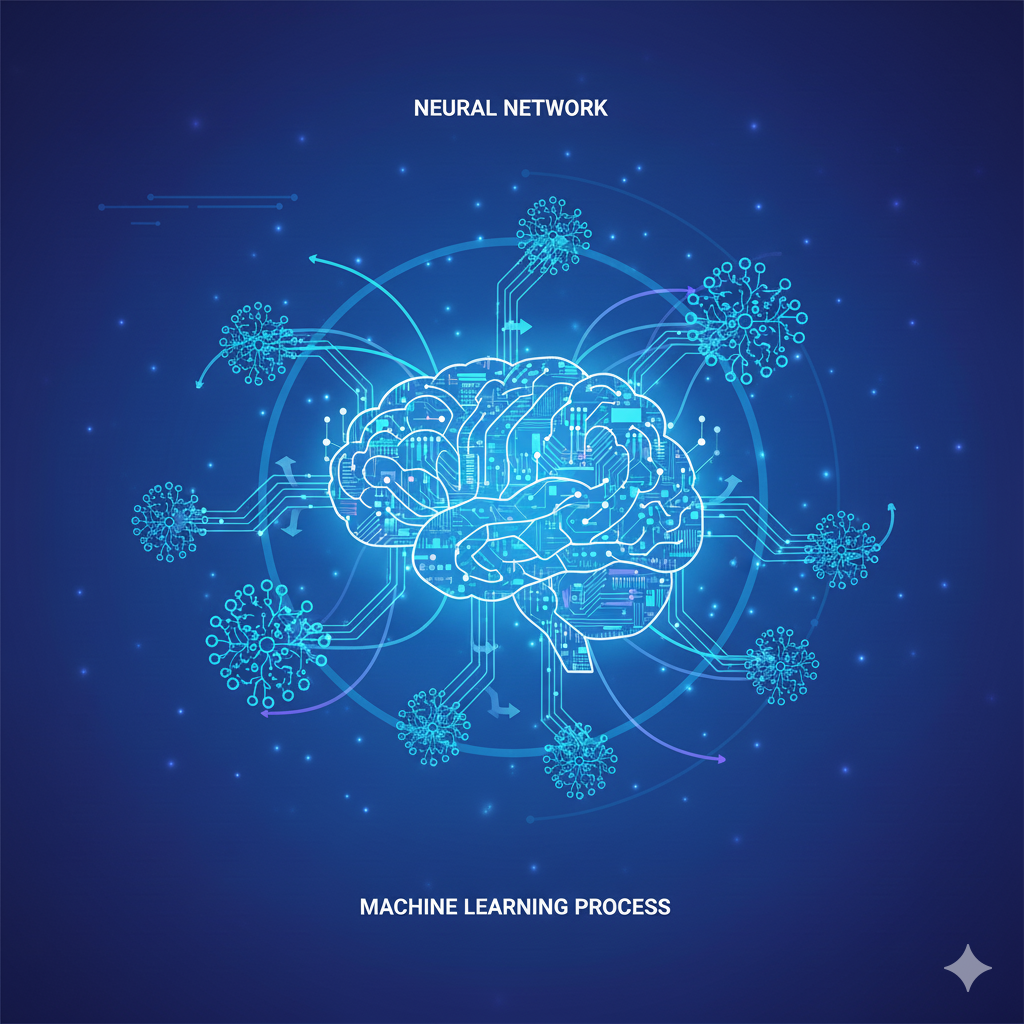
Neural networks are computational models, inspired by the structure of the human brain, that form the core of modern deep learning. They consist of interconnected nodes, or "neurons," organized into layers: an input layer that receives data, one or more hidden layers that perform complex computations, and an output layer that produces the final result. Each connection between neurons has an associated weight, which is adjusted during a training process. Through a method called backpropagation, the network learns by repeatedly analyzing vast amounts of data, measuring the error in its predictions, and modifying these weights to improve its accuracy over time. This allows neural networks to recognize intricate patterns and relationships in data, making them exceptionally powerful for tasks like image recognition, natural language processing, and forecasting.
Generative Artificial Intelligence is a branch of AI focused on creating new, original content—such as text, images, audio, video, and computer code—rather than simply analyzing or categorizing existing data. It works by training advanced machine learning models, like deep neural networks, on vast amounts of information so they can learn complex underlying patterns, structures, and rules. When given a prompt or instruction by a user, the AI applies this learned knowledge to generate entirely novel outputs that mimic human creativity, powering popular everyday tools like Claude, image generators, and AI coding assistants.
Call To Action
Duis aute irure dolor in reprehenderit in voluptate velit esse cillum dolore eu fugiat nulla pariatur. Excepteur sint occaecat cupidatat non proident, sunt in culpa qui officia deserunt mollit anim id est laborum.
Call To Action








Pricing
Our Competing Prices
Ut possimus qui ut temporibus culpa velit eveniet modi omnis est adipisci expedita at voluptas atque vitae autem.
Free
$0 / month
- Aida dere
- Nec feugiat nisl
- Nulla at volutpat dola
- Pharetra massa
- Massa ultricies mi
Business
$19 / month
- Aida dere
- Nec feugiat nisl
- Nulla at volutpat dola
- Pharetra massa
- Massa ultricies mi
Developer
$29 / month
- Aida dere
- Nec feugiat nisl
- Nulla at volutpat dola
- Pharetra massa
- Massa ultricies mi
F.A.Q
Frequently Asked Questions
-
Non consectetur a erat nam at lectus urna duis?
Feugiat pretium nibh ipsum consequat. Tempus iaculis urna id volutpat lacus laoreet non curabitur gravida. Venenatis lectus magna fringilla urna porttitor rhoncus dolor purus non.
-
Feugiat scelerisque varius morbi enim nunc faucibus a pellentesque?
Dolor sit amet consectetur adipiscing elit pellentesque habitant morbi. Id interdum velit laoreet id donec ultrices. Fringilla phasellus faucibus scelerisque eleifend donec pretium. Est pellentesque elit ullamcorper dignissim. Mauris ultrices eros in cursus turpis massa tincidunt dui.
-
Dolor sit amet consectetur adipiscing elit pellentesque habitant morbi?
Eleifend mi in nulla posuere sollicitudin aliquam ultrices sagittis orci. Faucibus pulvinar elementum integer enim. Sem nulla pharetra diam sit amet nisl suscipit. Rutrum tellus pellentesque eu tincidunt. Lectus urna duis convallis convallis tellus. Urna molestie at elementum eu facilisis sed odio morbi quis
-
Ac odio tempor orci dapibus. Aliquam eleifend mi in nulla?
Dolor sit amet consectetur adipiscing elit pellentesque habitant morbi. Id interdum velit laoreet id donec ultrices. Fringilla phasellus faucibus scelerisque eleifend donec pretium. Est pellentesque elit ullamcorper dignissim. Mauris ultrices eros in cursus turpis massa tincidunt dui.
-
Tempus quam pellentesque nec nam aliquam sem et tortor consequat?
Molestie a iaculis at erat pellentesque adipiscing commodo. Dignissim suspendisse in est ante in. Nunc vel risus commodo viverra maecenas accumsan. Sit amet nisl suscipit adipiscing bibendum est. Purus gravida quis blandit turpis cursus in
-
Tortor vitae purus faucibus ornare. Varius vel pharetra vel turpis nunc eget lorem dolor?
Laoreet sit amet cursus sit amet dictum sit amet justo. Mauris vitae ultricies leo integer malesuada nunc vel. Tincidunt eget nullam non nisi est sit amet. Turpis nunc eget lorem dolor sed. Ut venenatis tellus in metus vulputate eu scelerisque. Pellentesque diam volutpat commodo sed egestas egestas fringilla phasellus faucibus. Nibh tellus molestie nunc non blandit massa enim nec.
Team
Our Hardworking Team
Ut possimus qui ut temporibus culpa velit eveniet modi omnis est adipisci expedita at voluptas atque vitae autem.

Walter White
Chief Executive Officer
Sarah Jhonson
Product Manager
William Anderson
CTO